The Genetic Roots of Massage

Genetic Roots of Massage ImageOften overlooked in the ongoing quest for a coherent identity for the massage profession are its evolutionary roots. In other words, what is the genetic basis for what we now call massage?

In the animal kingdom the general impulse to touch one another is termed social touch and is not only clearly evident in our primate ancestors but has also been identified in insects, birds, bats and virtually all mammals. That means that social touch has been hard wired into our genomic heritage for over 200 million years. What part of social touch gave rise to massage?

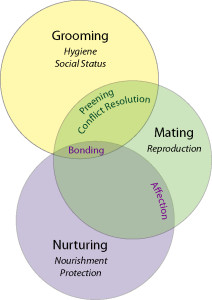
In primates, social touch can be divided into three overlapping functional categories: nurturing, grooming, and mating.

    • Nurturing touch originated from the need of infant mammals to be fed and protected.
    • Social grooming evolved for hygienic reasons, the need to keep the hair, fur, feathers and other skin coverings clean and free of leaves, twigs, insects, parasites and other objects.
    • The reproductive/mating instinct is fundamental to all animals for propagation of their species.
Genetics_img_2

Other overlapping functions of the varieties of social touch are also important. All three are examples of bonding behavior in its broadest sense of the word. Not only does touch tie parents to their offspring, mates to each other and individuals to the family or tribe, but touch has two other deep existential functions that often get overlooked. Touch creates a subjective sensation in  recipients that validates their unique individuality (bonding to myself) while, at the same time, it provides a “reality check” of their objective presence in and connection to the exterior environment. In an era of increasingly virtual relationships both of these benefits take on a new significance.

Grooming and nurturing kinds of touch overlap with mating touch in the forms of preening and affection, as noted in the illustration. Grooming and mating touch in some species, such as hominids, are also overlap when they are used for conflict resolution or reconciliation.

Wither professional massage?
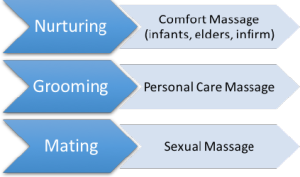
Genetic RootsAll massage done today by trained practitioners can trace its roots to at least one of these instinctual categories touching.

While every massage can be said to have a nurturing component (as described above in the discussion of bonding), nurturing touch is specifically the progenitor for what could be called comfort massage. These massage practitioners either provide massage services or massage training for populations such as the very young, the very old and the infirm. Examples include infant massage, geriatric massage and hospice massage.

Next, the grooming instinct has birthed the largest category of professional massage services: the personal care massage.

Parents or other family members are the primary groomers of their infants and children. They attend to the hygiene of their hair, nails, ears, nose, eyes and, most importantly, of their skin. They bathe and anoint their young with oils, lotions, and powders and, in this interaction, give them their first experience of the benefits of interpersonal touch.

As our children get older and more independent they begin to assume many of these grooming responsibilities for themselves. But society has also developed a whole economic sphere that can perform these functions called personal care services and its occupational categories include:

    • Hair stylists
    • Manicurists
    • Skin Care Specialists
    • Makeup artists
    • Massage practitioners

Most professional massage being provided today is personal care massage and it is easy to argue that it is more necessary than ever. With the emergence of higher levels of consciousness and more complex social systems, humans have the dubious distinction of being the only primate that can choose to override its natural instincts and live without interpersonal touch. Indeed, in many contemporary cultures, touching is now demonized, restricted or outright prohibited. Most people walk around today with a touch deficit. Personal care massage is one of the few ways that this primal need for touch can be safely met.

Finally, professional sexual massage services are a clear outgrowth of the mating touch instinct and, where they are not illegal, these days are often euphemistically described as “adult” or “tantric” massage.

Implications for our professional identity

Health care massage is the label that most massage schools, associations prefer for massage services. However, using touch techniques to ameliorate pain or injuries is actually a second order of massage services once removed from instinctual nurturing or grooming touch. It could be argued that the genetic roots of health care massage are  in self-touch, i.e. rubbing my sore spot to make it feel better. It wasn’t until some primates (and most particularly human primates) developed a capacity for empathy (feeling the pain of another) that interpersonal touch for relief became conceivable, i.e. rubbing your sore spot to make it feel better.

That’s not to say that health care or wellness massage can’t have the same benefits of comfort and personal care massage. It can and often does. However, it is the difference between eating chicken soup because you are hungry and eating (or feeding someone) chicken soup to cure what ails you. The former is instinctual and the latter requires a higher level of intention.

That distinction is important and often overlooked. The best use of massage is not to act as an ambulance at the bottom of a cliff (health care treatment), but rather to be the guard rail at the top of the cliff (health maintenance). Conflating (personal care) “massage” with (health care) “massage therapy” over the past 30 years has, unfortunately, resulted in the wide spread impression that massage is only useful when something has gone wrong. If we want to have a coherent identity for professional massage, it will have to include, but make a distinction between, both massage and massage therapy.

If you have any comments or thoughts about the genetic roots of our profession, please share them below.

What we need to know about touch

Skin stimulation (touching) is essential to maintaining physical, psychological and social well-being, according to an ever-increasing body of scientific literature. Since touch is the fundamental tool through which massage professionals interact with those who pay for our services, it seems obvious that we should have the deepest understanding of touch and touching. So, how do the skilled touch professions become the recognized experts on the subject of touch and touching?

I would like to propose an outline for a comprehensive body of knowledge about the sense of touch. I believe the skilled touch professions, as a community, already has access to this information, just not in one place. There still is no comprehensive textbook on touch for the massage profession or any other profession for that matter.

While every practitioner does not need to be an expert in every aspect of touch and touching, every practitioner should be familiar with all of the elements present in a touch experience. Obviously, that means that all schools and teachers of professional touch should be able to address these topics. Think of the following categories as chapters in that as yet unwritten textbook.

  • The evolutionary development of touching: Our genetic heritage
  • The anatomical structures and physiology of skin
  • The developmental requirements for human touching
  • The variety of cultural attitudes toward touching
  • The subjective perception of the initiator of touch
  • The subjective perception of the receiver of touch
  • The intention of the initiator of touch
  • The psycho-social-physical benefits of touching
  • The mechanics of touching
  • The manifestations of touching
  • The history of professional touching
  • Touch research
  • The institutional regulation of touching

Clearly, there is a lot to know about touch and touching. It is also obvious that schools which train skilled touch professionals tend to emphasize only a few of the categories above, in particular the mechanics of touching. That is not surprising for three reasons.

  1. Both academia that researches skilled touch and the vocational schools that teach skilled touch have been hampered by the touch-phobic milieu of the culture.
  2. As a result, academic interest in touch research has lagged far behind the attention paid to the other four primary senses.
  3. And, without the science, that comprehensive textbook on touch referred to earlier has not been written.

Fortunately, all of that has begun to change dramatically in the past generation as, in particular, the massage industry has successfully legitimized a place for skilled touch in the modern world. Primary credit for that success has to be given to the public and private massage associations, massage schools, their practitioners and businesses. While we don’t yet have a touch-positive culture, we are definitely moving in that direction. That will continue to spur interest in touch research and eventually result in the development of those crucial textbooks.

What do you think a comprehensive body of knowledge about touch and touching should include? Please add your comments below.

Massage is Sensational

Brain OrgasmA recent article in The Atlantic about a phenomenon called ASMR (autonomous sensory meridian response) reminded me of how little we celebrate the purely sensational nature of massage.

ASMR is a subjective sensory experience that typically includes highly pleasurable tingling in the head triggered by external audio or visual stimuli such as whispering, tapping or watching certain videos. Possibly because someone early on began referring to this sensation as a “brain orgasm,” the ASMR meme went viral with articles appearing on Slate, Time, and Huffington Post as well as numerous podcasts and radio programs. YouTube already lists nearly 2 million videos on the subject.

I had two reactions when I first read about ASMR. The first was, “What’s the fuss about? Every time I get a massage, I tingle all over, including in my head and brain.” My second thought was, “How come massage doesn’t have 2 million videos on how good massage feels?”

Professional massage exists on a social acceptability spectrum that can be summarized into four major categories: Sexual, sensual, wellness, and therapy. For the past 30 years the goal of the mainstream massage industry has been to highlight the latter two categories while downplaying the first two in an attempt to create as much distance as possible between massage and any hint of prostitution.

In the process, the fact that, first and foremost, massage feels good has gotten lost. That is unfortunate because, as science is now discovering, feeling good is probably one of the best things that we can do for our ongoing health and well being.

Learning how to stimulate a parasympathetic (relaxation) response, as massage does quickly and so effectively, is crucial to the daily health and renewal of virtually every physiological system in our bodies, not to mention the maintenance of a healthy psycho-social balance.

“Massage is not just pampering,” popular magazine headlines try to convince us. I say, what’s wrong with pampering if it boosts the immune system, lowers blood pressure, reduces stress hormones, increases oxytocin and heightens heart rate variability, a marker of parasympathetic response? A simple, caring massage is also an unconditional validation of my existence that nurtures both internal and external empathy. What’s not to like?

All massage is sensational. It makes us feel more and it makes us feel better. What a gift is the massage that banishes the numbness with which we armor our bodies and our spirits. Let us celebrate the sensational essence of massage and start making those videos.

Haptics: The Science of Touch

Last week I saw a commercial for the new Cadillac XTS that featured an innovative touch technology called the Safety Alert Seat. The system sends vibrating pulses to drivers through the seat cushion if they drift out of their lane without a turn signal activated or if there is threat from the front or rear, such as when backing blind out of a parking space.

“It’s akin to someone tapping on your shoulder in a crowd to get your attention,” said, General Motors Active Safety Technical Fellow Raymond Kiefer. “Using the tactile sense to communicate crash threat direction provides an effective and intuitive way to cut through the clutter of visual and auditory sensory information that drivers routinely experience.”

Cool!

Chart comparing Massage to Haptic research

Number of annual peer-reviewed research papers.
Source: EBSCOhost

This technology had been developed in a field of touch research that I have been following for the past 15 years called “haptics,” derived from the Greek word meaning “pertaining to the sense of touch.” Thus, if you are studying touch, you are studying haptics.

Since the only thing that all 100+ modalities of massage and bodywork have in common is that they are all based on touch, it would seem only natural that the massage industry would have a close association with the folks doing haptic research. Unfortunately, that is not the case. Even the recently published groundbreaking textbook on massage therapy research (Massage Therapy: Integrating Research and Practice) makes no mention of haptic research.

As noted in the accompanying chart, annual research in massage has actually leveled off in the past five years while annual haptic research surpassed massage research ten years ago and continues to grow steadily each year.

Who is doing haptics research?

There are scores of companies developing products based on haptics research. Many do their own research and others partner with academic institutions such as:

Disney Research is an example of a major corporation investing in touch research: Surround Haptics – Immersive Tactile Experiences

Why are they doing haptic research?

Most research in haptics has focused on extending the human ability to reach, explore, grasp, manipulate and get feedback from the world around us. Applications can be found in robotics, prosthetics, remote medicine and surgery, hazardous environments, manufacturing, communications and education.

Closer to home, the phone vibrating in your pocket and the joystick on your gaming console are both a result of haptics research.

In the future, haptics will become an essential aspect of virtual human interaction in such arenas as business meetings and classrooms. Sound waves are being studied for their ability to mimic touch making virtual handshakes within the realm of possibility.

How is this important to massage?

Since massage and haptics have never interfaced with one another, at first glance, they may not appear to have much in common. But that is definitely not the case. Here are some reasons why we should be working together.

Defining touch

One of the outcomes of haptics research has been to define the discreet constituents of touch mechanics (movement, friction control, vibration, contact force, pressure, duration) and to develop models for discriminating texture, softness, ridgidity, temperature, moisture, shape, proprioception/orientation and weight/heft.

All of these components are critical to massage and thus essential to informed massage education, practice, evolution and research.

Standardizing touch

A serious flaw in virtually all massage research to date is the lack of standardized protocols. “Subjects received ten-minutes of massage to the lower back,” is not a particularly useful sentence in a massage research paper because it is difficult, if not impossible, to duplicate.

We need to define a common vocabulary of touch far beyond effluerage, petrissage and tapotement. Iris Burman and Sandy Friedland made an attempt in their book TouchAbilities: Essential Connections, but far more refinement is required.

One of the reasons that I feel fortunate that my massage modality is Japanese acupressure is because there is a built in precision to the acupressure points, the channels they lie upon and the techniques that are used to stimulate them. I am a big fan of quality control in massage, so I also teach chair massage as one would a martial art, that is through “Katas,” highly choreographed sequences of techniques, point locations and body mechanics. The kata model is one of the few in massage that allows for high standardization of protocols.

Touch tools

As haptics has defined the parameters and functions of touch, out of necessity the field has also had to develop tools that apply and measure each aspect of touch. These tools can obviously be used by massage researchers to apply standardized touch, measure touch or used as controls in touch research.

The biology of touch

Haptics is as interested in the anatomy and neurophysiology of touch as is massage and they have the money to pay for functional MRIs. We need to be monitoring their work, sharing information and cross-fertilizing our fields.

The psychology of touch

Research into how haptic aspects affect the psychology of gaming (the thrill of driving on that racetrack), computer shopping (where you can feel the texture of the skirt you are viewing on your monitor), and mutual virtual touching continues to expand. Investigating the psychology of touch is in its infancy and the massage industry needs to be accessing research and resources wherever we can.

Massage is poor; commerce is rich

The massage industry has suffered from an inferiority complex (fighting a negative public perception) and consequent lack of imagination for decades. Because of our fear of embracing touch (see related article), we have allowed commercial interests outside of the profession to charge ahead with a touch research agenda that is almost totally off the radar of the massage industry.

The massage industry should be in the middle of all touch research, not standing on the sidelines. It is time to take off the blinders and begin dialoging and collaborating with the commercial and academic interests who are spending millions of dollars researching touch.

Let’s get in the driver’s seat, folks!

The Realms of Massage

The first professional massage I ever received was around 1970 in an old Russian Banya on the near-North Side of Chicago called the Luxor Baths. The clientele was a mix of the old Jewish expats who had moved to the suburbs (Nelson Algren used to hang out here) and the new Hispanic locals. Luxor was an artifact from an earlier time complete with swimming pool, wet and dry saunas, a steam room and metal tables where friends would beat and brush each other with soapy oak leaf brooms.

Luxor also had a massage room and, with some encouragement from my friends, I finally gave massage a try. It was a memorable experience and I have been hooked ever since.

Notably, I didn’t get my first massage because something was wrong with me. I got a massage because it made me feel great and that is the experience I have been seeking to share with the world ever since.

Traditionally, within most cultures, professional massage has operated in two very discreet economic realms: the personal care services industry and the health care industry.

  • As a personal care service, massage is found in saunas, spas, hair salons, in the foot massage services provided in the streets of near- and far-Eastern Asian countries as well as neighborhood bathhouses and as various forms of seated massage now throughout the world. This is the kind of massage I received at the Luxor Baths.
  • In the health care industry, massage evolved through a variety of healing modalities, such as osteopathy and chiropractic, orthopedic practice, nursing and physical therapy (called physiotherapy in many countries).

These two domains were easily distinguished from one another both by terminology (customers vs. patients) and by intention (relaxation vs. treatment) and there was generally little confusion or overlap.

That clarity started to dissolve in the 1970s as a new economic arena began to emerge. It was called “health promotion” or “wellness” and was a reaction to the dominant health care paradigm, which in fact did not focus on health care, but rather sickness care.

The counterculture that emerged from the sixties first manifested this new approach by embracing such practices as natural childbirth, organic and vegetarian diets, supplements and herbs, and varieties of personal growth dubbed the “human potential movement.” Books such as Our Bodies Ourselves began to advocate rejection of the cult of experts in favor of personal responsibility and control. The goal became prevention, not treatment, and creating a balance that integrated the mind, body and spirit into a unified whole.

Inevitably, business began to capitalize on this cultural trend and the fitness industry was born. Health clubs replaced gyms, Nike shoes replaced sneakers, wellness centers replaced spas and self-help programs replaced the confessional. Also about this time, corporate wellness programs started to get a foothold as companies began to suspect that the only way to reduce their ever-rising health care costs was by encouraging employees to maintain good health through proper exercise, diet, and emotional balance.

Massage slipped easily into this new and exciting economic domain. The Esalen Institute in California championed new approaches to massage that focused on mind/body integration as well as a new category called “bodywork” that included innovative modalities developed by Ida Rolf, Milton Trager  and Moshe Feldenkrais.

The advent of this new wellness arena, however, has muddied the once clear distinction between personal care services and health care services as both try to carve for themselves a slice of the wellness pie.

And where has that left the massage industry? Also very muddied. According to the massage schools, associations and regulators, massage is no longer a personal care service, it is a health care service. I can no longer get a massage like I did 40 years ago at the Luxor Baths. Now I have to get massage therapy. But I don’t want a health care massage. I don’t even want a wellness massage. I just want to lie down and bliss out in the hands of someone who makes me feel good. I don’t care if the practitioner has 50 or 500 hours of training. If I like the massage, I will go back. If I don’t, I won’t.

We need to bring back and validate the personal care massage realm. That is where the most growth is happening (chair massage and franchise table massage), that is where the jobs are, and that is where I want to get my massage.

Do you believe massage should reclaim its identity as a personal care service? Does defining massage exclusively as “therapy” confuse the public and needlessly restrict our growth?